Guyana is growing quickly. New offices, hotels, commercial developments, oil and gas activity, retail centres, hospitals, and public facilities are placing more pressure on Georgetown and other high-demand areas. As the city becomes busier, one issue is becoming harder to ignore: parking.
For many drivers, parking in Georgetown already means circling crowded streets, competing for limited spaces, navigating congestion, or relying on informal roadside parking. For businesses, it can mean frustrated customers, delayed staff, reduced foot traffic, and underused property. For developers and public agencies, it raises a larger question: how can Guyana support growth without allowing traffic and parking pressure to slow the city down?
The answer is not simply more surface parking. In high-value urban areas, land is too important to be consumed by wide, low-yield parking lots. Guyana needs modern parking infrastructure that uses land efficiently, supports commercial growth, improves safety, and creates long-term value.
That is where multi-storey car parks come in.
Parking Is Now an Infrastructure Issue in Guyana
Parking is often treated as a small inconvenience, but in fast-growing cities it becomes a serious infrastructure challenge. When vehicles spill onto roadsides, traffic moves more slowly. When businesses cannot provide convenient parking, customers go elsewhere. When hospitals, hotels, offices, and government facilities lack organised parking, the surrounding streets carry the burden.
In Georgetown, where land is valuable and demand is increasing, the old approach of spreading vehicles across surface lots is no longer enough. A surface car park may solve a short-term problem, but it uses a large footprint for a limited number of vehicles. A multi-storey car park takes the same land and stacks capacity vertically, creating far more parking spaces per acre.
For a city with growing commercial, hospitality, healthcare, energy, and government activity, that difference matters.
What Is a Multi-Storey Car Park?
A multi-storey car park, also called a multi-level parking structure or parking garage, is a purpose-built structure designed to park vehicles across multiple levels. Instead of spreading parking across a wide surface lot, vehicles are organised vertically through ramps, open floor plates, clear circulation routes, lighting, security systems, and controlled entry and exit points.
For Guyana, a well-designed multi-storey car park can support:
- Commercial developments and office buildings.
- Hotels and hospitality properties.
- Hospitals and healthcare facilities.
- Retail centres and malls.
- Government and municipal facilities.
- Oil and gas offices and workforce support facilities.
- Mixed-use developments and urban redevelopment projects.
The goal is not only to store vehicles. The real value is in creating a safer, more efficient, revenue-generating piece of infrastructure that supports the surrounding development.
Why Surface Parking Is Not Enough
Surface parking has its place, especially where land is abundant and vehicle demand is low. But in dense or high-value areas, it quickly becomes inefficient.
Every acre used for surface parking is an acre that cannot be used for offices, shops, apartments, hotels, public space, healthcare expansion, or other higher-value development. As land values rise, the cost of keeping vehicles at ground level becomes harder to justify.
A multi-storey car park can deliver five to ten times more vehicle capacity per acre, depending on the site and design. That means developers and landowners can solve parking demand while preserving more land for productive use.
In practical terms, that can mean:
- More customers able to access a retail or commercial property.
- Better tenant attraction for office and mixed-use developments.
- Less congestion around hospitals and public facilities.
- More organised urban traffic flow.
- Stronger long-term asset value for landowners.
The Investment Case for Modern Car Parks
A multi-storey car park is more than a construction project. Properly located and operated, it can become a revenue-generating asset.
Parking income can come from hourly, daily, monthly, reserved, corporate, event, or mixed-use arrangements. In a high-demand location, that creates recurring revenue from day one of operations. For commercial property owners, the indirect gains can be just as important: improved access, higher foot traffic, stronger tenant appeal, and increased surrounding property value.
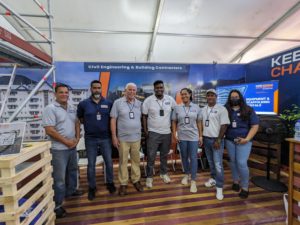
In the presentation delivered by Kee-Chanona Guyana Inc., a sample 500-space Georgetown car park scenario showed how the economics can work. Using a 6-level structure, an estimated 120,000 square feet, 50 percent average occupancy, and a sample parking rate of GYD $300 per hour, the model projected meaningful annual net operating income and an estimated payback period of approximately 5.5 years.
Those figures are illustrative and depend on location, demand, operating hours, rates, construction cost, financing, and management. Still, they demonstrate the core point: in the right location, parking infrastructure can solve a city problem while also supporting a strong business case.
Why Post-Tensioned Construction Matters
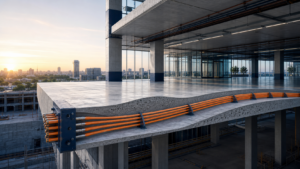
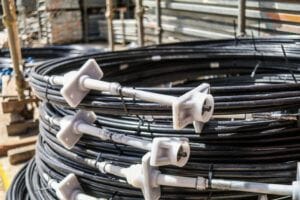
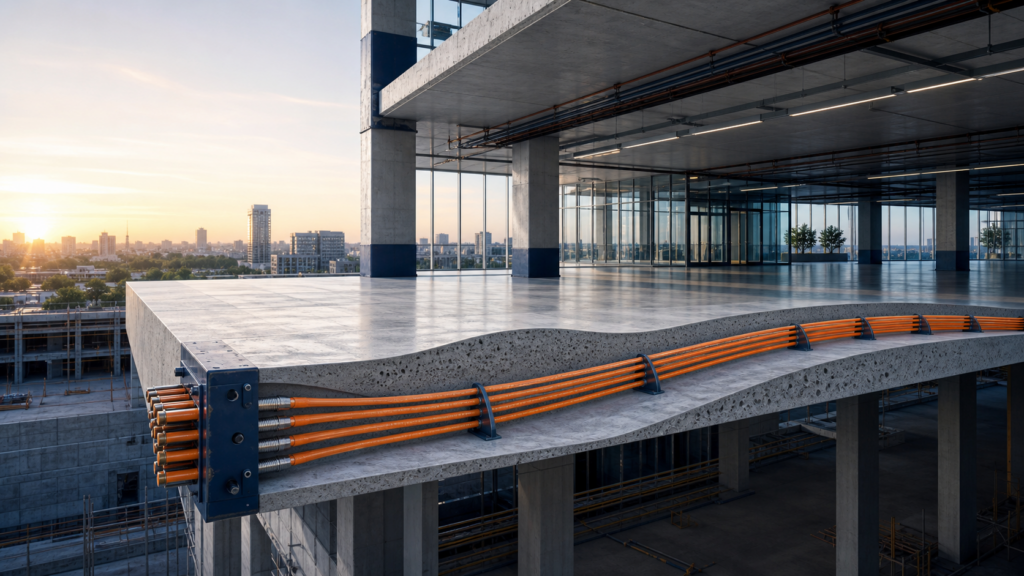
Not all car parks are built the same way. Kee-Chanona’s approach uses post-tensioned concrete technology, a construction method that uses high-strength steel tendons within concrete to create stronger, lighter, and more efficient structures.
For multi-storey car parks, post-tensioning has major advantages:
- It can reduce concrete quantities by approximately 25 percent compared with conventional reinforced concrete.
- It can reduce rebar weight by approximately 65 percent.
- It allows longer column-free spans, often in the range of 60 to 120 feet.
- It creates more open floor plates with better vehicle movement.
- It can reduce structural weight and foundation loads.
- It supports faster construction cycles.
For drivers, the benefit is simple: fewer obstructing columns, wider visibility, smoother circulation, and more natural light. For developers, the benefits are equally important: better parking efficiency, faster delivery, lower material intensity, and a structure designed around long-term use.
The Garage Beam System: Faster, Leaner Construction
Kee-Chanona’s presentation also highlighted the Garage Beam System, a proprietary formwork methodology developed to accelerate car park construction while maintaining quality.
The system is designed around practical site efficiency:
- Beam forms are assembled once and reused floor after floor.
- Forklifts can move deck panels and beam forms, reducing dependence on cranes.
- A lean forming crew can manage the system efficiently.
- High-density overlay plywood helps deliver a smooth concrete finish.
- Repetition across floors improves speed, quality, and predictability.
For a country like Guyana, where construction demand is rising and delivery timelines matter, this type of construction methodology can make a major difference. Speed matters. Labour productivity matters. Material efficiency matters. A car park solution must be buildable, repeatable, and commercially practical.
Proven Caribbean Experience
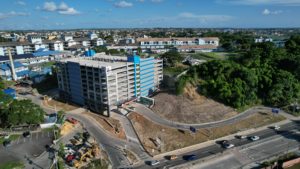
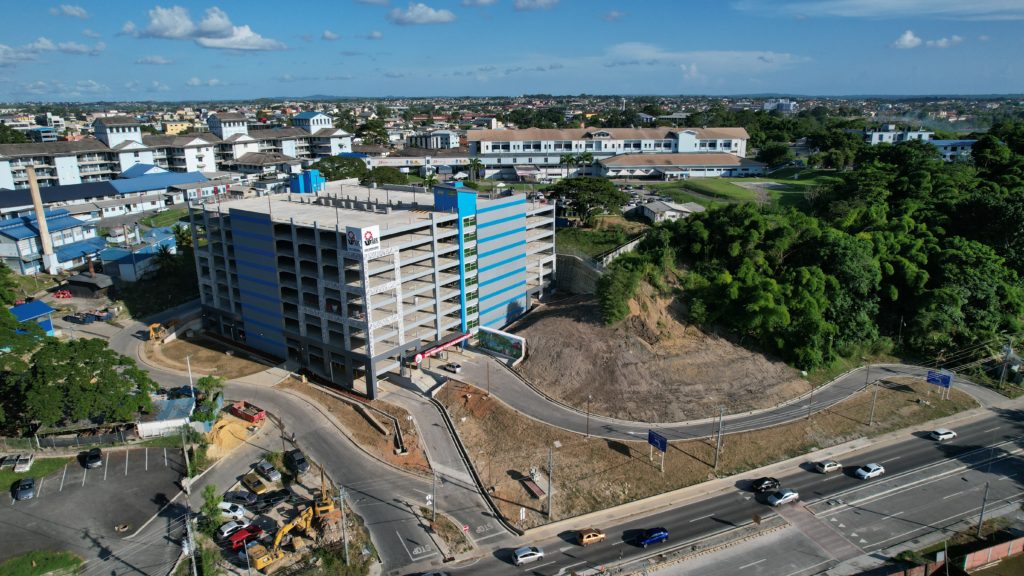
Kee-Chanona is not approaching multi-storey car parks as a theory. The company has delivered major parking structures in Trinidad and Tobago, including Furness City Park in Port of Spain, Victoria Keys, and the San Fernando General Hospital multi-storey car park.
Furness City Park is one of the region’s landmark post-tensioned car park projects, with large open spans and a high-capacity design built in a constrained urban setting. The San Fernando General Hospital car park further demonstrates the application of post-tensioned parking infrastructure for a critical public facility, with large clear spans, multiple levels, elevators, surveillance, and modern parking infrastructure.
That experience matters for Guyana because multi-storey car parks require more than concrete and ramps. They require practical design-build coordination, structural expertise, traffic flow planning, durability, safety, and a construction method that can deliver efficiently in Caribbean conditions.
Who Should Consider a Multi-Storey Car Park in Guyana?
Multi-storey car parks are especially relevant for landowners and organisations where access, customer movement, and land use are business-critical.
Commercial developers can use parking to attract tenants and free land for higher-value rentable space. Hotels can improve guest convenience with secure, covered parking. Hospitals can reduce stress for patients, visitors, doctors, and staff. Retail owners can increase customer access and support higher footfall. Government and municipal agencies can reduce roadside congestion while creating structured, managed parking capacity. Oil and gas operators can support expanding workforces with efficient parking near offices and operational centres.
The best opportunities are usually found in high-demand locations where parking pressure is already visible and land has strong alternative value.
A Better Parking Future for Georgetown
A modern car park should not be seen as an isolated structure. It should be part of a wider urban solution.
When designed properly, a multi-storey car park can help remove vehicles from crowded streets, reduce unsafe parking, improve pedestrian movement, support nearby businesses, and create cleaner traffic patterns. It can also become a catalyst for further development by making dense commercial areas easier to access.
For Georgetown, this is especially important. The city is a commercial centre, a government centre, a hospitality destination, and a growing base for the energy sector. If parking is not planned properly, congestion becomes a hidden cost on growth. If parking is solved intelligently, the city becomes easier to use, invest in, and develop.
Why KCGI Is Ready to Support Guyana’s Next Step
Kee-Chanona Guyana Inc. brings Guyana a locally focused extension of Kee-Chanona’s wider Caribbean construction capability. Backed by decades of regional experience, KCGI is positioned to support developers, property owners, investors, and public agencies looking for modern, efficient parking infrastructure.
The opportunity is clear. Guyana can continue to lose valuable urban land to surface parking and roadside congestion, or it can move toward structured, revenue-generating parking assets designed for the next stage of national growth.
Multi-storey car parks are not just about where people leave their vehicles. They are about land use, business access, urban order, public safety, and long-term investment value.
Guyana’s growth deserves parking infrastructure built for the future.
Build Guyana’s Next Multi-Storey Car Park
Whether you own land, manage a commercial development, represent a public agency, operate a hospital or hotel, or are exploring infrastructure investment, KCGI can help assess how a modern multi-storey car park could work for your site.
To discuss car park construction, post-tensioned parking structures, or parking infrastructure opportunities in Guyana, contact Kee-Chanona Guyana Inc.
Kee-Chanona Guyana Inc.
Building Solid Foundations Together


2 Responses
This is a good engineering response to a seemingly probable future issue.
The problem isnt future! It’s here already!!